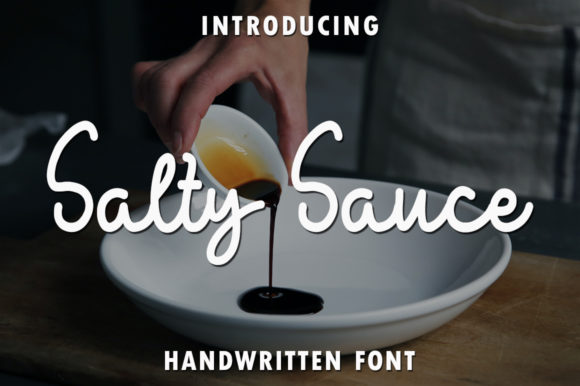
Salty Sauce Font: A Sweet and Delicate Typography Review
I was staring at a brand board for a new boutique bakery concept. The mood was soft, joyful, and romantic—a place that felt like a handwritten note. The client’s brief emphasized delicate, personalized touches. I knew I needed a script font, but I'd been cycling through options that felt either too rigid or too chaotic. Then I loaded Salty Sauce, a sweet and delicate handwritten font, into the layout. Immediately, the blank canvas felt less intimidating.
Salty Sauce for Wedding Invitations and Elegant Branding
Salty Sauce is, first and foremost, a script handwritten font with a specific personality: dainty and joyful. Its strokes are fluid but controlled, with a rhythmic bounce that avoids being overly whimsical or childish. This is crucial. In my test, I used it to draft the bakery's core brand phrase, “Handmade with Love.” On the screen, the words looked crafted, not just typed. The font’s inherent sweetness perfectly echoed the brand’s ethos without resorting to cliché. It’s easy to see why Salty Sauce is ideal for writing wedding invitations; it carries that same celebratory, personal warmth. But in branding, it translates beautifully to any project seeking a romantic, personalized touch—think bespoke skincare lines, floral studios, or intimate cafés.
Testing Salty Sauce in Logo Design and Brand Applications
For the logo draft, Salty Sauce performed exceptionally as a primary logo typeface. I set the bakery’s name in it and placed it on a simple shop sign mockup. The readability at a moderate size was clear, and the font’s delicate nature gave the entire identity an upscale, artisanal feel. On a packaging mockup for a cookie box, the font added that crucial handwritten quality that suggests care and attention. This is where a script handwritten font like Salty Sauce shines: it humanizes the brand instantly. On the business card and website header, it served as a powerful display element, creating an immediate emotional hook. However, I’d caution against using it for long body text on websites or detailed nutritional information on packaging. Its decorative strength is best reserved for headlines, short phrases, and accent text.
Pairing Salty Sauce with Other Fonts for a Complete System
No font lives alone in a brand system. For the bakery project, I paired Salty Sauce with a clean, lightweight sans-serif for all supporting text—menu details, address information, body copy on the website. This pairing created a perfect visual hierarchy: the romantic script font draws attention and sets the mood, while the practical sans-serif ensures clarity and readability. This is a classic and effective approach. You could also pair it with a simple serif font for a more classic, editorial feel, suitable for a stationery brand or a creative studio’s identity. The key is to let Salty Sauce be the personality driver and choose a supporting typeface that grounds the design with functionality.
Where Salty Sauce Works Best and Where to Use Caution
From my testing across a brand board, social media layouts, and print mockups, Salty Sauce excels in specific arenas. It’s perfect for any design needing a romantic, personalized touch: not just cards and invitations, but product labels for handmade goods, social media graphics announcing a launch, or the hero text on a landing page for a service-based business like a wedding planner. Its joyful bounce makes it great for positive, celebratory messaging. Conversely, it’s not suitable for formal corporate reports, lengthy paragraphs, or any interface requiring ultra-small font sizes. Its delicate lines can lose definition if scaled too small or output on low-resolution materials. Always test it on your actual mockups—print a sample business card, view the website header on a mobile device—before finalizing client work.
Practical Considerations for Using the Salty Sauce Font
As an experienced designer, my final note is always about practical application. When considering Salty Sauce for a project, review its included features. Many handwritten fonts come with alternates and ligatures that can add even more customization to your logo or special phrases. Check its multilingual support if your client’s audience is global. Crucially, always verify the commercial font licensing. If you’re using Salty Sauce in a brand identity for a bakery, their packaging, website, and merchandise, you need a license that covers all those commercial applications. This protects you and your client. A font like this is an investment in the brand’s visual voice, so ensuring its legal use is part of professional practice.
In the end, for the bakery concept, Salty Sauce provided that elusive quality: authentic charm. It didn’t feel like a default font choice; it felt like a deliberate design decision that elevated the entire mood board. Its sweet and delicate nature, captured in every letter, can transform a generic concept into a brand with heart. For designers seeking a script handwritten font that balances joy with sophistication, for projects that thrive on a personal touch, Salty Sauce is a compelling tool to have in your typography library.